

More business owners are asking whether they can stop absorbing the cost of accepting credit cards and pass that cost to customers.
The honest answer is yes, sometimes. But seeing another business add a fee does not mean the same approach will work for yours.
Whether a fee program qualifies depends on the type of fee, the card being used, the merchant category, how the payment is accepted, and whether the processor and technology support it. Calling something a service fee or convenience fee does not automatically make it one.
The Part Most Businesses Never Hear
A compliant fee program is not simply a line item added at the register or placed on an invoice.
It has to follow a recognized card-network program and be supported by the merchant’s processor, gateway, or point-of-sale system.
- Identify the card correctly
- Prevent surcharges from being added to debit and prepaid cards
- Calculate the permitted amount
- Produce the required disclosures
- Identify the surcharge within the transaction data
Visa requires a credit card surcharge to be included in the transaction amount and identified in the transaction data. Visa also requires written notice to the merchant’s acquirer at least 30 days before the surcharge is announced or first assessed.
Mastercard’s public guidance is currently being updated, including its merchant notification and registration requirements. That is exactly why the current process should be confirmed with the merchant’s acquirer before anything goes live.
A fee appearing on a receipt does not prove the program was configured correctly.
These Programs Are Not Interchangeable
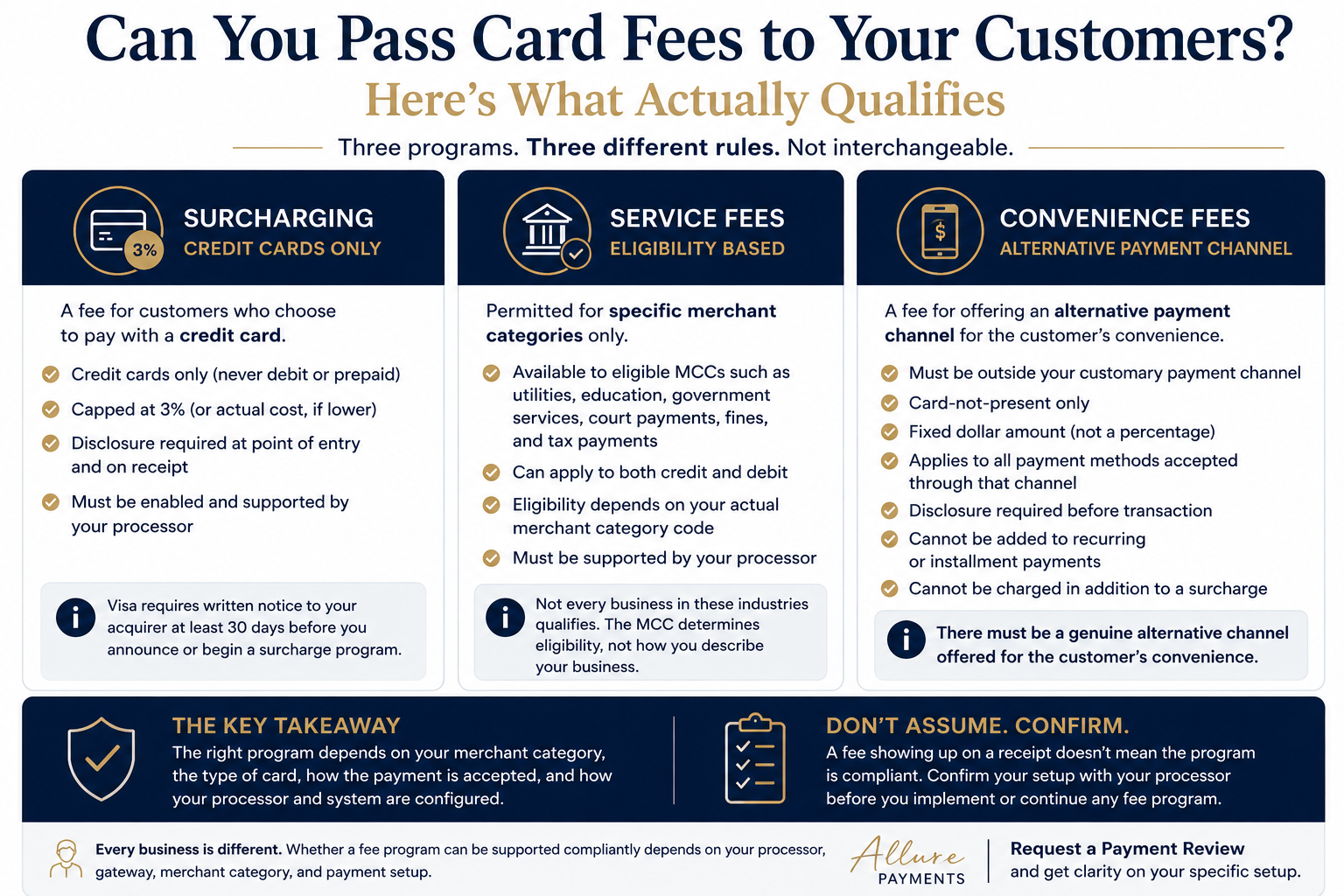
Surcharging
A surcharge is an additional fee charged when a customer chooses to pay with a credit card.
Credit is the important word.
A surcharge cannot be added to a debit or prepaid card, even when the customer selects “credit” at the terminal.
For Visa credit card transactions in the United States, the surcharge cannot exceed 3 percent. It may need to be lower when the merchant’s actual cost of accepting the card is lower.
The surcharge must also be clearly disclosed.
For an in-person business, disclosure is required at the entrance and where the customer pays.
For online and other card-not-present transactions, disclosure must be presented before the transaction is completed.
The surcharge must also appear on the customer’s receipt.
This is why manually adding the same percentage to every card transaction is risky.
The system must know the difference between credit, debit, and prepaid.
Service Fees
A service fee is not a general option available to every business.
Eligibility depends on the merchant’s actual merchant category code.
Under Visa’s current U.S. rules, permitted categories include certain utilities, schools, colleges, vocational schools, court payments, fines, tax payments, and government services.
That does not mean every organization connected to government, education, or utilities automatically qualifies.
The merchant must be boarded under an eligible MCC, and the specific program must be supported by the acquirer or processor.
Calling a charge a “service fee” does not make it compliant.
Convenience Fees
A convenience fee is charged for giving the customer a genuine alternative way to make a payment.
It is not simply a fee for using a card.
For example, a business that normally accepts payments in person might offer a separate phone or online payment channel for the customer’s convenience.
Under Visa’s U.S. rules, the fee must:
Be charged through an alternative channel outside the merchant’s customary payment channel
Apply only in a card-not-present environment
Be a fixed dollar amount, not a percentage
Apply to all payment methods accepted through that channel
Be disclosed before the transaction is completed
Give the customer an opportunity to cancel
Not be added to recurring or installment transactions
Not be charged in addition to a surcharge
A business that operates entirely online cannot simply call its ordinary online checkout an alternative payment channel.
There has to be a real convenience being offered outside the business’s customary way of accepting payment.
Where Businesses Get Into Trouble
Most businesses are not intentionally trying to violate card-network rules.
They are usually copying something they saw elsewhere.
A competitor adds 3 percent, so they add 3 percent.
A software provider calls something a service fee, so they assume it qualifies as one.
An invoice allows an additional line item, so they assume the fee can be entered manually.
A salesperson says the system can pass on the cost, so they assume compliance is included.
Those assumptions are where the risk begins.
The name placed beside the fee does not determine whether it qualifies.
The transaction type, card type, merchant category, technology, disclosures, applicable laws, and card-network rules determine that.
What Actually Protects the Business
Before implementing a fee program, confirm:
- Which program the business is using
- Whether the merchant category is eligible
- Whether the processor and gateway support that program
- Whether debit and prepaid cards are handled correctly
- Whether the fee is within the permitted amount
- Whether the transaction data identifies the fee properly
- Whether every required disclosure is in place
- Whether the receipt displays the correct information
- Whether state and federal requirements have also been reviewed
Do not rely only on what the terminal, invoice, or receipt appears to be doing.
Confirm how the account is actually configured.
Already Charging a Fee?
It is still worth reviewing.
Especially when nothing has gone wrong yet.
A fee program can run for months without a complaint and still be structured incorrectly.
Finding that out before a customer complains, the processor contacts the business, or the program has to be shut down is always the better outcome.
Know What You Are Running
Passing card costs to customers may be an option, but the right approach is not the same for every business.
Your merchant category, processor, gateway, payment channels, card types, and current technology all determine what can be supported and how the program should be structured.
This is not something to copy from another business or configure based on what appears to work elsewhere.
A Payment Review looks at your specific setup.
I will review how your current program is configured, confirm what is supported, and identify anything that may need to change.
If everything is structured correctly, I will tell you.
If it is not, you will understand where the issue is, why it matters, and what needs to happen next.

This article is for educational purposes and is not legal advice. Card-network rules and applicable laws can change. Confirm current requirements with your acquirer, processor, and legal counsel before implementing or changing a fee program.